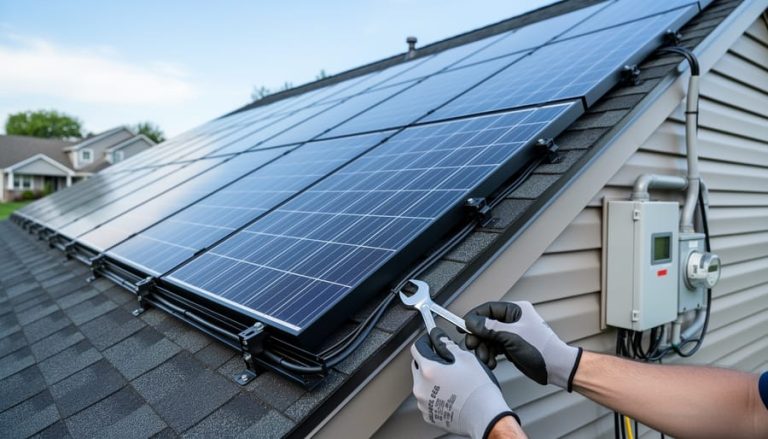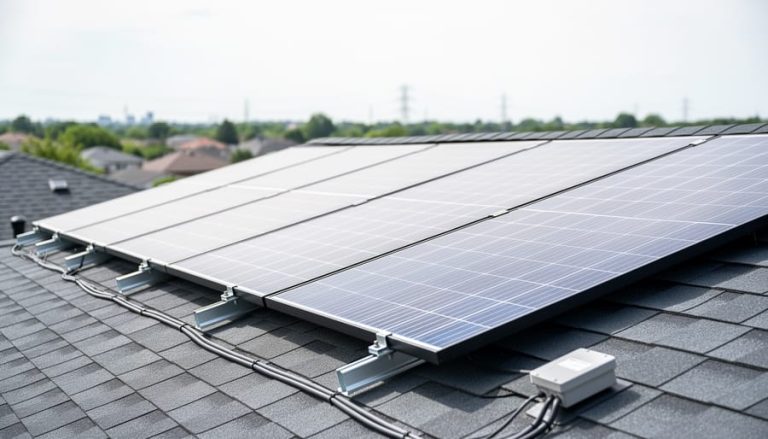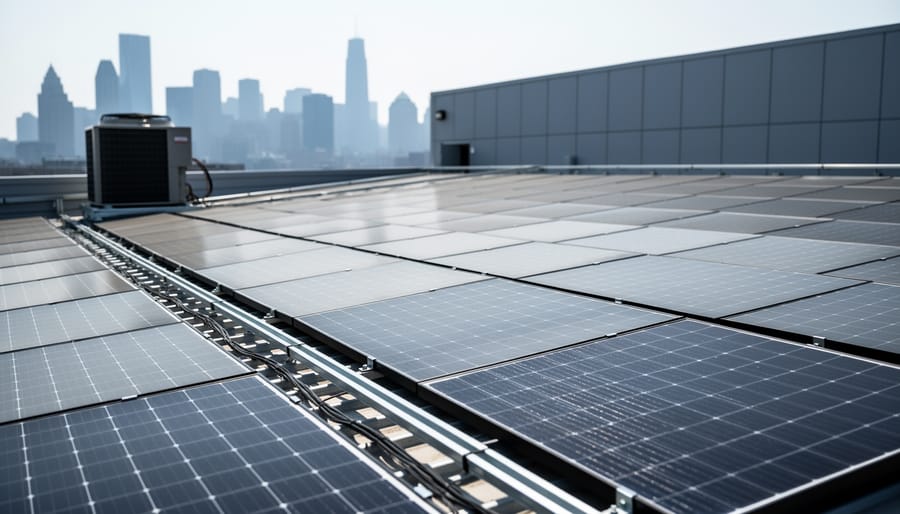
Commercial rooftop solar panels differ from residential systems in three critical ways: scale, structural requirements, and return on investment. Where a home installation might use 15 to 25 panels, commercial systems often require 100 or more, demanding specialized mounting systems that distribute weight across flat or low-slope roofs while withstanding wind loads specific to larger buildings. The investment ranges from tens of thousands to several million dollars depending on your facility size, but commercial systems typically deliver faster payback periods thanks to higher electricity consumption, demand charge reductions, and accelerated federal tax depreciation.
You’re reading this because you’re responsible for a decision that will affect your company’s bottom line for the next 25 years. That’s exactly how long today’s high-efficiency commercial panels from manufacturers like Maxeon, REC, LONGi, Jinko, and Trina are warrantied to produce power, with current models achieving efficiency ratings between 22% and 24%. Just as you’ve likely noticed neighbors using solar across residential communities (now over 5 million U.S. households according to Consumer Reports’ 2026 testing), commercial adoption is accelerating as businesses recognize solar as infrastructure, not experiment.
This guide walks you through the buying factors that matter, compares panel technologies with verified 2026 performance data, and shows you how to match your facility’s profile to the right system configuration. We’ll also highlight the mistakes that cost businesses thousands in lost production or avoidable repairs, so you can approach quotes with confidence and clarity.
What Makes Commercial Rooftop Solar Different
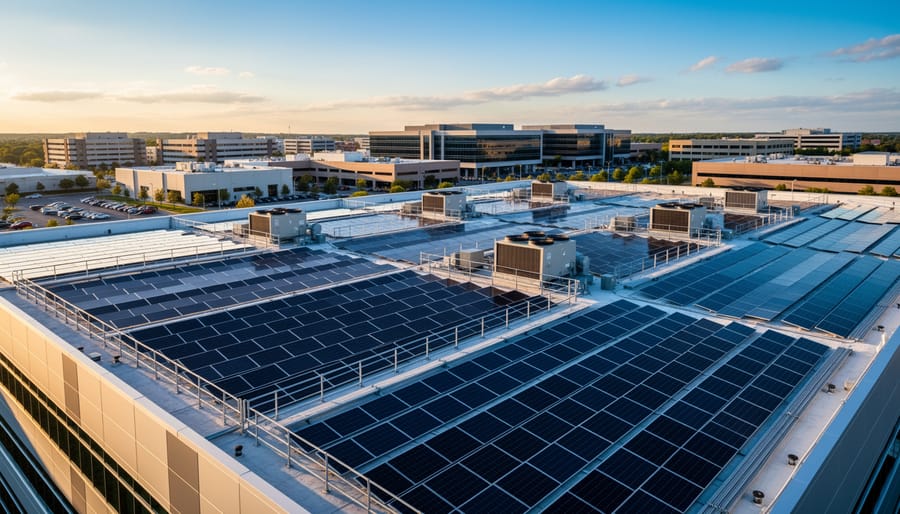
When businesses consider solar energy, they’re entering a different arena than homeowners. Commercial rooftop solar systems operate at a fundamentally larger scale, designed to power entire facilities rather than individual households. Where a residential system might use 15-20 panels to generate enough electricity for a family, commercial installations often deploy hundreds of panels across expansive rooftops, generating power to run offices, manufacturing equipment, refrigeration systems, and entire operations.
This scale difference creates unique advantages. Commercial buildings typically consume far more energy during daylight hours, precisely when solar panels produce maximum output. This alignment means businesses can offset a larger portion of their electricity costs immediately, without relying heavily on battery storage. The economics shift dramatically at this scale too. While upfront costs are higher, commercial systems benefit from economies of scale and more generous tax incentives, often achieving payback periods of 3-7 years compared to 8-12 years for residential installations.
The installation requirements also differ significantly. Commercial roofs must meet stricter structural standards to support the added weight of hundreds of panels and mounting systems. Installation teams need specialized expertise in commercial building codes, electrical systems that handle much higher voltages, and coordination with facility operations to minimize business disruption. These aren’t obstacles, they’re opportunities to create robust, professionally engineered systems that deliver reliable performance for decades.
Perhaps most importantly, commercial solar connects your business to a broader movement. The 5 million U.S. households now powered by solar demonstrate growing momentum toward community clean energy and commercial adoption amplifies that impact. Your decision to invest in rooftop solar sends a visible message about your commitment to sustainability while capturing genuine economic value. That combination of financial returns and environmental leadership makes commercial solar an increasingly smart choice for forward-thinking businesses.
Key Factors When Choosing Commercial Solar Panels
Efficiency Ratings and Space Constraints
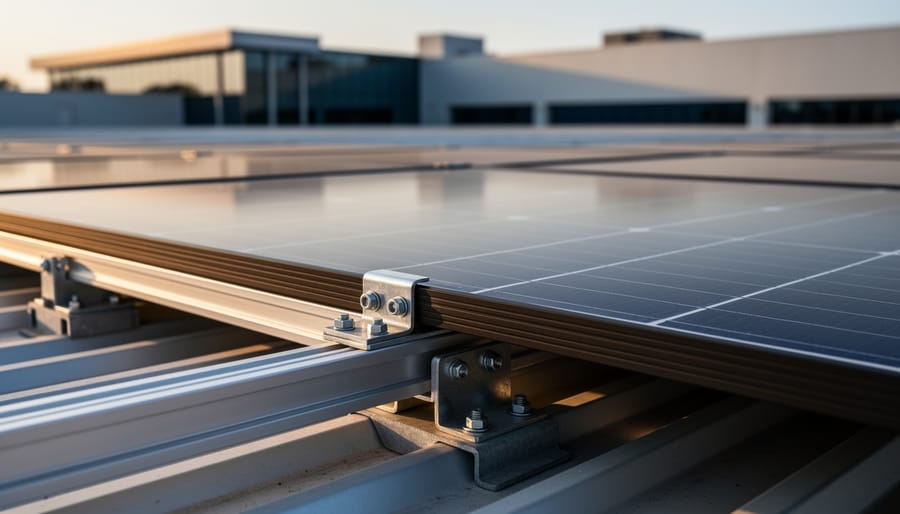
Efficiency ratings tell you what percentage of sunlight a panel converts into usable electricity. High-performance commercial panels typically achieve 22% to 24% efficiency, meaning they generate significantly more power from the same roof area than older or budget models hovering around 15% to 18%. This difference matters enormously when your available rooftop space is limited.
Consider a business with 2,000 square feet of suitable roof area. Installing panels at 22% efficiency might produce enough electricity to offset 80% of your monthly energy bill, while 18% efficient panels on that same roof might only cover 60%. You’re not just getting a few extra kilowatt-hours, you’re potentially unlocking additional savings that compound over decades, and in some cases, making solar viable on buildings where lower-efficiency panels simply wouldn’t meet your energy goals.
Space constraints become even more critical for businesses operating from smaller facilities or those with rooftop equipment, HVAC units, or structural limitations that reduce usable installation area. A restaurant with a crowded rooftop might only have 1,200 square feet available after accounting for ventilation systems and access pathways. Choosing panels at the higher end of the efficiency spectrum lets you maximize production within those real-world boundaries.
The efficiency premium usually adds 10% to 20% to upfront costs, but that investment often pays for itself through greater energy production. Many businesses also qualify for federal tax credits and state programs listed in resources like the DSIRE incentive database which can offset the initial price difference while you benefit from superior long-term output.
Energy Production Capacity
Understanding your business’s energy needs is the foundation of choosing the right commercial rooftop solar system. Start by reviewing your electricity bills from the past 12 months to identify your average monthly consumption in kilowatt-hours (kWh). Look for seasonal patterns, too, many businesses use more energy during summer cooling months or winter heating periods.
Once you know your baseline consumption, you can match it to panel output. A typical commercial solar panel produces between 300 and 400 watts under ideal conditions. Multiply that by the number of panels your roof can accommodate and factor in your location’s average sun hours to estimate total production. Your installer can provide detailed calculations, but having a general sense of your energy profile helps you evaluate their proposals intelligently.
Businesses that have successfully sized their systems often share a common approach: they plan for growth. If you’re expanding operations or adding equipment in the next few years, build that into your capacity planning now. Adding panels later costs more than installing a slightly larger system upfront. The goal is matching your energy needs without over-building, creating a system that delivers meaningful savings from day one while supporting your business’s future.
Durability and Warranty Coverage
Commercial rooftop solar panels face demanding conditions, intense sun exposure, temperature extremes, wind loads, and decades of weather, so durability and warranty protection are essential buying considerations. Look for panels built with corrosion-resistant frames, tempered glass, and robust weatherproofing, especially if your facility is in a coastal or high-wind region.
Understanding warranties helps you evaluate long-term value. Product warranties cover manufacturing defects and physical failures, typically ranging from 10 to 25 years for commercial panels. This protection ensures you won’t face unexpected replacement costs if panels crack, delaminate, or suffer electrical failures. Performance warranties, meanwhile, guarantee that panels will maintain a minimum power output over time, usually 80-85% of original capacity after 25 years. Both warranties matter, but performance guarantees are particularly important since they protect your energy production and financial returns.
When comparing options, choose manufacturers with established track records and strong warranty terms. Panels from companies like Maxeon, REC, LONGi, Jinko, and Trina typically include comprehensive coverage that reflects their confidence in long-term reliability. Verify warranty transferability if you might sell the property, and confirm what conditions could void coverage. Quality warranties backed by financially stable manufacturers give you peace of mind that your investment remains protected throughout its operational life.
Installation Costs and Long-Term Savings
Understanding the financial picture is central to a confident buying decision. Commercial rooftop solar panel costs have two components: what you pay upfront and what you save over time. Focusing only on the initial price point misses the bigger economic story.
Installation expenses depend on several variables, system size, roof complexity, panel selection, and local labor rates. The good news is panel pricing has become more accessible. For instance, the TOPCon module spot price for N-type panels fell below $0.55 per watt in early 2026, bringing high-efficiency technology within reach of more businesses. While panels represent just one piece of total rooftop solar cost these improvements matter when you’re building a large-scale system.
The real value emerges when you calculate total cost of ownership across 25 years or more. Commercial systems typically pay for themselves through energy savings, often within seven to ten years depending on electricity rates and system size. After that payback period, you’re generating nearly free electricity for another 15-plus years. Factor in rising utility prices, available tax incentives, and the hedge against future energy volatility, and the long-term economics become compelling. Think in decades, not quarters, and the investment case strengthens considerably.
Installer Experience and Local Expertise
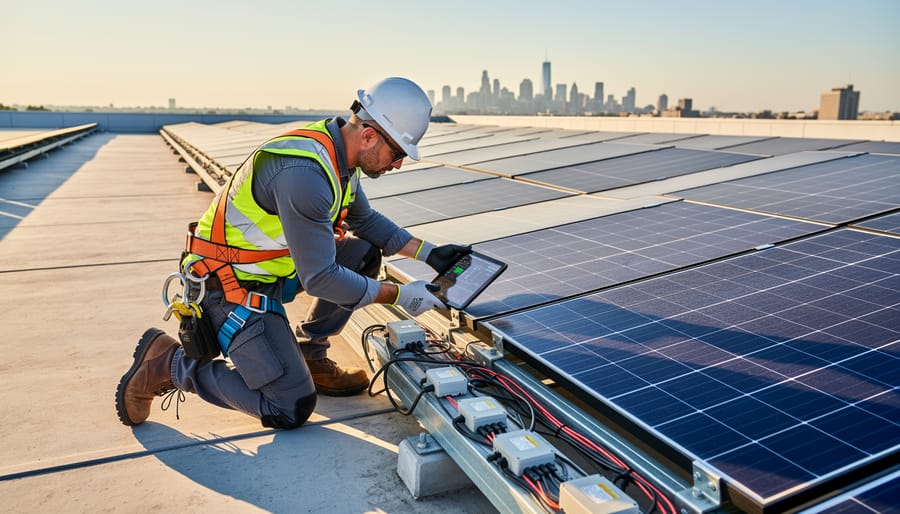
The installer you choose matters as much as the panels themselves. A skilled commercial solar contractor brings specialized expertise that residential installers often lack, navigating complex building codes, managing commercial electrical systems, and coordinating installations that minimize business disruption. Consumer Reports emphasizes selecting installers with proven commercial experience, and local knowledge makes a significant difference. An installer familiar with your region understands local permitting processes, utility interconnection requirements, and weather conditions that affect system design.
Regional partnerships matter for long-term system performance and service. Companies like Sunergy Solutions, which serves Connecticut, Massachusetts, Maine, New Hampshire, Rhode Island, Vermont, and Virginia, develop deep familiarity with Northeast building regulations and climate considerations. Similarly, Advanced Green Technologies specializes in commercial installations in Fort Lauderdale and Miami, bringing expertise in Florida’s unique requirements. These local relationships mean faster response times for maintenance, better warranty support, and installers who understand the specific challenges your roof and location present. A distant installer might offer lower prices, but the value of accessible, experienced local support becomes clear when you need system adjustments or encounter unexpected issues during installation.
Types of Commercial Solar Panels Compared
Choosing the right solar panel technology means balancing three factors: how much power you can generate from available roof space, what you’ll spend upfront and over time, and how reliably the panels will perform for decades. The commercial solar market has evolved rapidly, and today’s high-performance options deliver efficiency ratings between 22% and 24%, giving businesses more power per square foot than ever before.
The main panel types break down along technology lines. Monocrystalline silicon panels, particularly the newer N-type TOPCon and HJT (heterojunction) variants, dominate the commercial space because they squeeze the most energy from limited roof area. These panels use single-crystal silicon cells that convert sunlight more efficiently than older technologies, which matters when every square foot of your roof counts toward your energy independence.
Among leading manufacturers, Maxeon stands out for premium installations where maximum output justifies higher investment. Their panels consistently hit the top end of the efficiency range, making them ideal for businesses with serious space constraints or particularly high energy demands. REC panels offer a strong middle ground, combining solid efficiency with competitive pricing, they’re popular among businesses that want reliable performance without premium pricing. LONGi, Jinko, and Trina represent the value-conscious tier, where efficiency might land closer to 21-22% but the total cost in 2026 makes them attractive for larger installations where roof space isn’t the limiting factor.
| Panel Brand | Typical Efficiency | Best Use Case | Key Consideration |
|---|---|---|---|
| Maxeon | 23-24% | Limited roof space, maximum output needed | Premium pricing requires strong ROI analysis |
| REC | 22-23% | Balanced performance and budget | Strong warranties and proven durability |
| LONGi, Jinko, Trina | 21-22% | Large roofs, cost-conscious projects | Economies of scale make lower efficiency viable |
The reliability question comes down to manufacturing quality and warranty terms. All major manufacturers offer 25-year performance warranties, but the details matter. Look for product warranties that cover at least 12 years (premium brands offer 25), and performance guarantees that promise panels will still produce at least 85-90% of their original output after 25 years. Manufacturing defects show up early if they’re going to appear, so longer product coverage gives you peace of mind.
Your roof characteristics help narrow the choice. A flat commercial roof with abundant space lets you prioritize cost-efficiency over peak performance, you can install more panels to compensate for slightly lower efficiency. A smaller or partially shaded roof demands high-efficiency panels to maximize every available spot. The technology itself has matured enough that choosing from established manufacturers like Maxeon, REC, LONGi, Jinko, and Trina means you’re getting panels proven in commercial installations across the country. What varies is the specific trade-off between upfront investment and long-term power generation that makes sense for your business.
Recommendations: Matching Panels to Your Business Needs
When your business is ready to invest in rooftop solar, matching the right panels to your specific situation makes all the difference. Here’s how to narrow down your options based on what matters most to your operation.
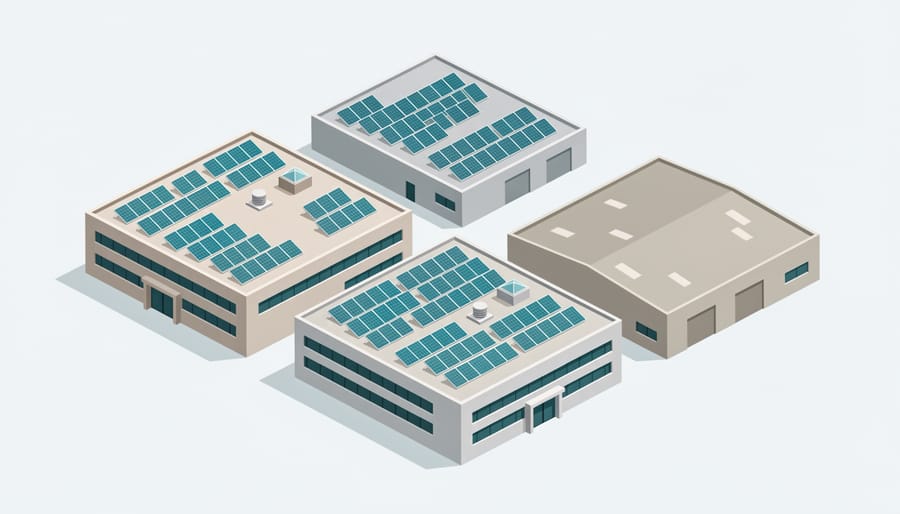
For businesses with limited roof spaceefficiency is your best friend. You’ll want panels in that 22% to 24% efficiency range, models from manufacturers like Maxeon or REC that extract maximum power from every square foot. A retail store with a compact rooftop or a warehouse hemmed in by HVAC equipment can’t afford to waste space on lower-performing panels. The higher upfront cost pays off because you’re generating the energy you need without expanding your footprint. Businesses in dense urban areas have found that prioritizing efficiency lets them achieve their energy goals even when rooftop real estate is scarce.
If you’re working within a tight budgetfocus on the sweet spot between performance and price. Mid-tier panels from manufacturers like Jinko or Trina offer solid efficiency (typically around 20-21%) at more accessible price points. You’ll generate less power per panel than premium options, but if you have adequate roof space, installing a few more panels can close that gap while keeping your total investment manageable. Many cost-conscious businesses have successfully balanced their financial constraints with their energy goals by choosing reliable mid-tier panels and planning for phased expansion as budgets allow.
Here are the key scenarios and what to prioritize:
- Limited roof space: High-efficiency panels (22-24%) from Maxeon or REC to maximize power output per square foot
- Budget-conscious projects: Mid-tier panels (20-21% efficiency) from Jinko or Trina with room to add capacity later
- Maximum energy production: Premium panels from LONGi or Maxeon combined with optimized panel placement
- Harsh climates: Panels with robust warranties and proven durability in extreme temperatures or high wind zones
- Future expansion plans: Modular systems that allow you to add capacity without redesigning your entire setup
For businesses chasing maximum outputthink manufacturing facilities or data centers with high energy demands, premium panels deliver the performance you need. Yes, you’ll pay more, but the difference in long-term energy production justifies the investment when every kilowatt-hour matters.
Regional factors matter too. Businesses in the Northeast partnering with experienced installers like Sunergy Solutions benefit from local expertise about snow loads and seasonal variations. In Florida, where Advanced Green Technologies serves Fort Lauderdale and Miami, installers understand hurricane-rated mounting and intense summer sun. Choose panels that match both your business model and your local environment.
Common Mistakes to Avoid
Businesses often stumble when choosing commercial rooftop solar panels by fixating on upfront cost alone. While it’s tempting to select the cheapest option, this approach overlooks total cost of ownership, the combination of installation expense, energy production over 25+ years, and maintenance requirements. A slightly higher initial investment in panels with 23% efficiency rather than 20% can mean significantly more electricity generated from the same roof space, shortening your payback period and maximizing long-term savings.
Another common pitfall is underestimating how much roof space you’ll actually need. Businesses sometimes assume they can fit enough panels for their energy goals without consulting detailed site assessments. If your available roof area is limited, choosing high-performance panels becomes essential rather than optional. Planning ahead prevents disappointing discoveries late in the solar installation process.
Many businesses also neglect warranty details, assuming all coverage is similar. Performance warranties guarantee your panels will still produce a certain percentage of their rated output after 25 years, while product warranties cover defects and failures. Understanding both types helps you compare offers accurately and protects your investment.
Finally, failing to plan for future energy needs creates regret down the line. Your business might expand, add equipment, or transition to electric vehicles. Designing a system that can accommodate growth, or at least leaves room for future panel additions, turns your solar investment into a flexible asset rather than a fixed solution. Each of these mistakes is avoidable with thoughtful evaluation and guidance from experienced professionals.
Frequently Asked Questions
How does panel efficiency affect my total return on investment?
Higher efficiency panels cost more upfront but generate more electricity per square foot, which matters significantly when roof space is limited. Over 25 years, a 23% efficient system on a constrained roof often delivers better financial returns than a cheaper 18% system that can’t meet your energy needs without expanding beyond available space.
Are premium panels worth the extra cost for my business?
Premium panels from manufacturers like Maxeon and REC make sense when you’re maximizing limited roof area, need maximum durability in harsh weather, or want the longest warranty coverage. If you have ample roof space and a tighter budget, mid-tier options from Jinko or Trina can deliver solid performance at lower cost while still meeting commercial standards.
What should I look for when comparing installer quotes?
Beyond price, evaluate the installer’s commercial experience, local references from similar businesses, and how thoroughly they assessed your specific roof conditions. A quality installer will explain equipment choices clearly, provide detailed warranty information, and show you actual production estimates based on your building’s characteristics rather than generic assumptions.
How long does commercial solar panel installation typically take?
Most commercial rooftop installations take two to six weeks from permit approval to final connection, depending on system size and roof complexity. The timeline includes engineering review, equipment delivery, physical installation, electrical work, and inspection, though permitting and utility interconnection processes before installation can add several weeks to the overall project schedule.
What’s the realistic lifespan of commercial solar panels?
Quality commercial panels are designed to last 25 to 30 years with minimal degradation, typically losing less than 0.5% efficiency annually. Most manufacturers guarantee at least 85% of original output at 25 years, meaning your panels will still generate substantial power well into their third decade of operation.
These questions reflect what businesses genuinely need to know when moving from research to decision. The efficiency question addresses the space-versus-cost trade-off that defines many commercial projects. Understanding that 5 million U.S. households already have solar, with adoption expected to double by 2030, helps contextualize these decisions within a proven, growing movement rather than an experimental venture.
The installer evaluation question deserves special attention because your choice of partner matters as much as your choice of panels. Regional specialists like Sunergy Solutions serving the Northeast and Virginia, or Advanced Green Technologies handling commercial projects in Fort Lauderdale and Miami, bring local knowledge that generic national installers can’t match. They understand regional weather patterns, local permitting requirements, and which equipment performs best in your climate.
When you’re comparing quotes, remember that the lowest bid rarely represents the best value. A thorough installer will spend time on your roof, analyze shading patterns throughout the year, and explain exactly why they’re recommending specific panels for your situation. That level of attention costs more initially but prevents expensive surprises and underperforming systems down the line.
Choosing commercial rooftop solar panels is more than a purchasing decision. It’s an investment in your business’s future and a meaningful contribution to the clean energy movement reshaping our economy. The 5 million U.S. households that have already adopted solar are part of a wave expected to double by 2030, and your business can be part of that transformation.
You now have the framework to evaluate efficiency ratings, compare panel technologies, match systems to your energy needs, and avoid common pitfalls. The next step is yours to take. Request quotes from experienced local installers who understand commercial projects. Ask detailed questions about warranties, performance guarantees, and long-term maintenance. Explore available incentives that can significantly improve your return on investment.
Every business that installs rooftop solar panels strengthens the broader community of organizations committed to sustainability. Your decision ripples outward, demonstrating to customers, employees, and competitors that renewable energy makes both financial and environmental sense. You’re not just cutting energy costs or meeting sustainability goals. You’re helping build the infrastructure for a cleaner, more resilient energy future.
The solar-powered economy is here, growing stronger each year. Your business has an opportunity to lead rather than follow. Start your journey today, and join the movement transforming how we power our world.